




Contact Us
info.littleofficers@gmail.com
Phone
+91 7042039300
+91 7042049700
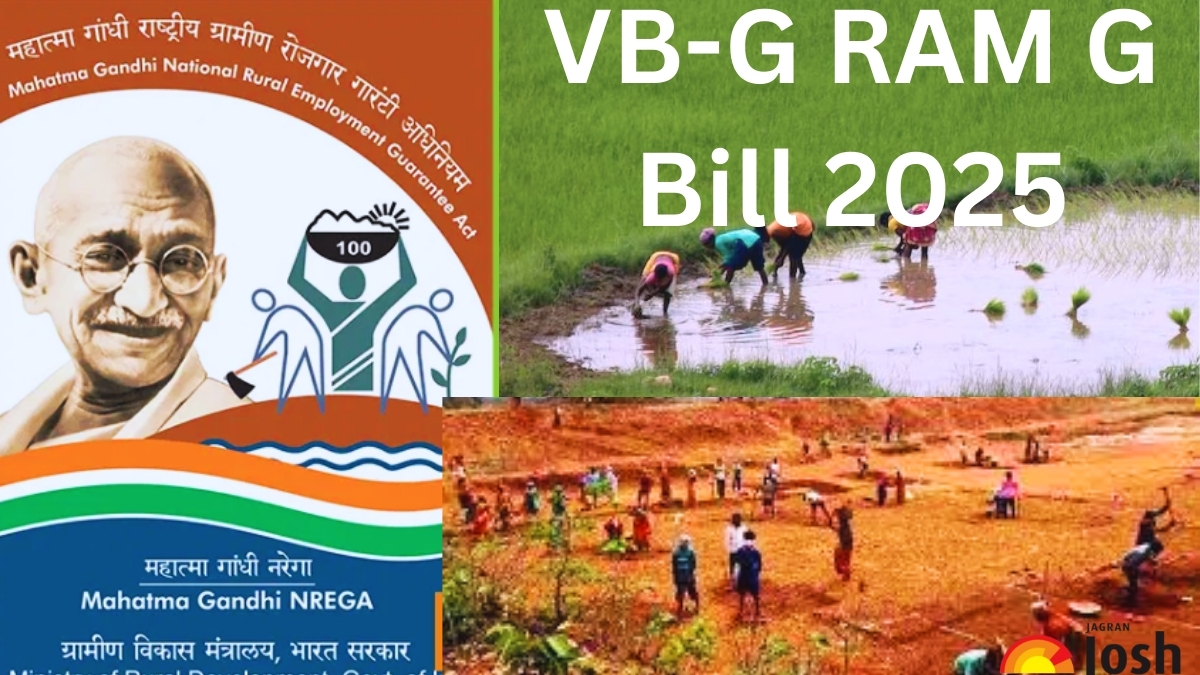
The Viksit Bharat—Guarantee for Rozgar and Ajeevika Mission (Gramin) (VB—G RAM G) Bill, 2025 was introduced in Lok Sabha on December 16, 2025. It seeks to replace the Mahatma Gandhi National Rural Employment Guarantee Act, 2005 (MGNREGA) with a framework that aligns rural development with India's vision of Viksit Bharat 2047.
Increase in number of guaranteed days of employment: MGNREGA guarantees at least 100 days of employment in a financial year to every rural household whose adult members volunteer for unskilled manual work. The Bill increases the guarantee to 125 days. Under MGNREGA, if a person seeking work is not provided employment within 15 days, the state government must pay them an unemployment allowance. The Bill retains this provision.
Fund sharing: Under MGNREGA, the central government provides the entire cost of wages for unskilled manual work, up to three-fourths of the material cost, and a share of administrative costs. State governments provide one-fourth of the material cost, administrative costs, unemployment allowance, and compensation in case of delay in wage payments. The Bill amends this to provide that the scheme will be implemented as a centrally sponsored scheme. State governments will notify a scheme consistent with the Bill, within six months from its commencement. The fund-sharing pattern between the central government and state governments will be 60:40 for all states other than the North-eastern and the Himalayan states (90:10). A state and the central government will share the cost of wages, material costs, and administrative costs in the above ratios. The state government will continue to pay unemployment allowance and compensation.
State governments to bear expenditure in excess of normative allocation: The Bill provides that the central government will determine state-wise normative allocation for each financial year. The parameters for these allocations will be prescribed by the central government under Rules. The state government will bear any expenditure incurred in excess of this allocation.
Pause on works during agricultural season: The Bill requires state governments to announce in advance a period of up to 60 days for every financial year during which works under the scheme will not be undertaken. This period will cover peak agricultural seasons, including sowing and harvesting.
Planning framework: Under MGNREGA, gram panchayats are responsible for identifying projects in their area under the scheme. The Bill retains this and requires them to prepare a plan for works. These works will focus on four thematic domains: (i) water security, (ii) rural infrastructure, (iii) livelihood-related infrastructure, and (iv) mitigation of extreme weather events. These plans will be integrated with the PM Gati Shakti National Master Plan and also aggregated at the national level.
Implementation and monitoring: MGNREGA establishes Councils at the central and state levels to undertake implementation and monitoring. The Bill retains these provisions and also provides that their composition will be specified under Rules. It constitutes the National Level Steering Committee which will provide high-level oversight, and recommend normative allocations. It also constitutes a Steering Committee for each state. Key functions of the State Committee include: (i) overseeing convergence with other programmes, (ii) aggregation of district plans into state plans, and (iii) coordinating with the National Committee.
Use of technology: The Bill provides for using: (i) biometric authentication for transactions, (ii) geospatial technology for planning and monitoring, (iii) mobile application-based dashboards for real-time tracking, and (iv) weekly public disclosure systems.
The VB-G RAM G Bill represents a change in India’s approach to rural employment, aligning the programme with the Viksit Bharat 2047 vision. By increasing the employment guarantee to 125 days and emphasising the creation of durable and climate-resilient assets, the Bill seeks to link wage employment with longer-term rural development outcomes.
The Bill is being seen as a way to transform rural development by expanding the scale of development interventions and is expected to create additional employment opportunities for rural households. Parliamentary and policy discussions will help in carving the way ahead for revolutionizing rural employment.
info.littleofficers@gmail.com
+91 7042039300
+91 7042049700